by Eyal Leviatan, Tasneem Watad, Roy Perry et al.
From Noisy Hardware to Scientific Discovery
By extending trusted quantum measurements beyond the classically controlled regime, this work shows how Qedma can transform commercially accessible quantum computers into reliable instruments for scientific investigation and discovery.
Precision Quantum Simulation of Floquet Quantum Matter
Using Qedma’s QESEM error-mitigation software on IBM Heron R3 hardware, this work resolves long-lived prethermal Floquet dynamics in quantum spin systems of up to 74 qubits. The experiments perform precision measurements of magnetization dynamics and reveal structured oscillations that persist over many drive cycles, showing that the driven many-body system does not simply relax toward featureless thermal behaviour. By extending these measurements to larger quantum circuits, the work enables finite-size scaling of the oscillation amplitude, providing evidence that the observed oscillatory response is not merely a small-system effect.
Beyond the Classically Controlled Frontier
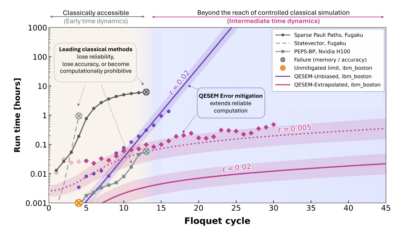
This result reaches a regime where neither raw quantum hardware nor leading classical simulation methods provide a reliable view of the dynamics. Without error mitigation, hardware noise would obscure the signal; at the same time, leading classical simulation methods no longer provide converged predictions in the relevant large-system, late-time regime. Tensor-network simulations fail to converge at the required depths, while sparse Pauli-path simulations remain strongly truncation dependent even after extensive computations on advanced GPUs and the Fugaku supercomputer. QESEM therefore enables precision measurements in a regime that the leading classical methods considered in the work cannot reliably access.
Trust Built Through Layered Validation
Trust in the result comes from a layered validation strategy designed for a regime where direct classical verification is no longer available. The team benchmarks the mitigated dynamics against exact statevector simulations in smaller systems, compares with classical methods in the regimes where those methods remain reliable, checks consistency between independent mitigation estimators, validates the superconducting-hardware noise model used by QESEM, and performs cross-platform checks on Quantinuum trapped-ion processors. Together, these tests support the conclusion that the observed late-time oscillations are genuine physical dynamics, not artefacts of hardware noise, extrapolation, or platform-specific behaviour.