Research
Resolving Structure in Prethermal Floquet Dynamics with Precision Quantum Computation

Resources Research Papers Last updated
A team from Pacific Northwest National Laboratory and the University of Washington demonstrates a hybrid pipeline that shrinks realistic chemistry problems to a size current quantum hardware can run, without discarding the correlation effects that make those problems hard. Ground-state energies were computed on Quantinuum and IBM devices. On the IBM runs the team used Qedma’s QESEM, accessed as a Qiskit Function, and reported that it outperformed the alternatives they tested.
Accurate quantum chemistry needs large basis sets and a balanced treatment of electron correlation. Current quantum hardware cannot support that directly: logical qubit counts, gate fidelities and circuit depths are all limiting.
The standard workaround is to define a small active space and solve within it, but a bare Hamiltonian restricted to a small active space loses most of the dynamical correlation that lives outside it.
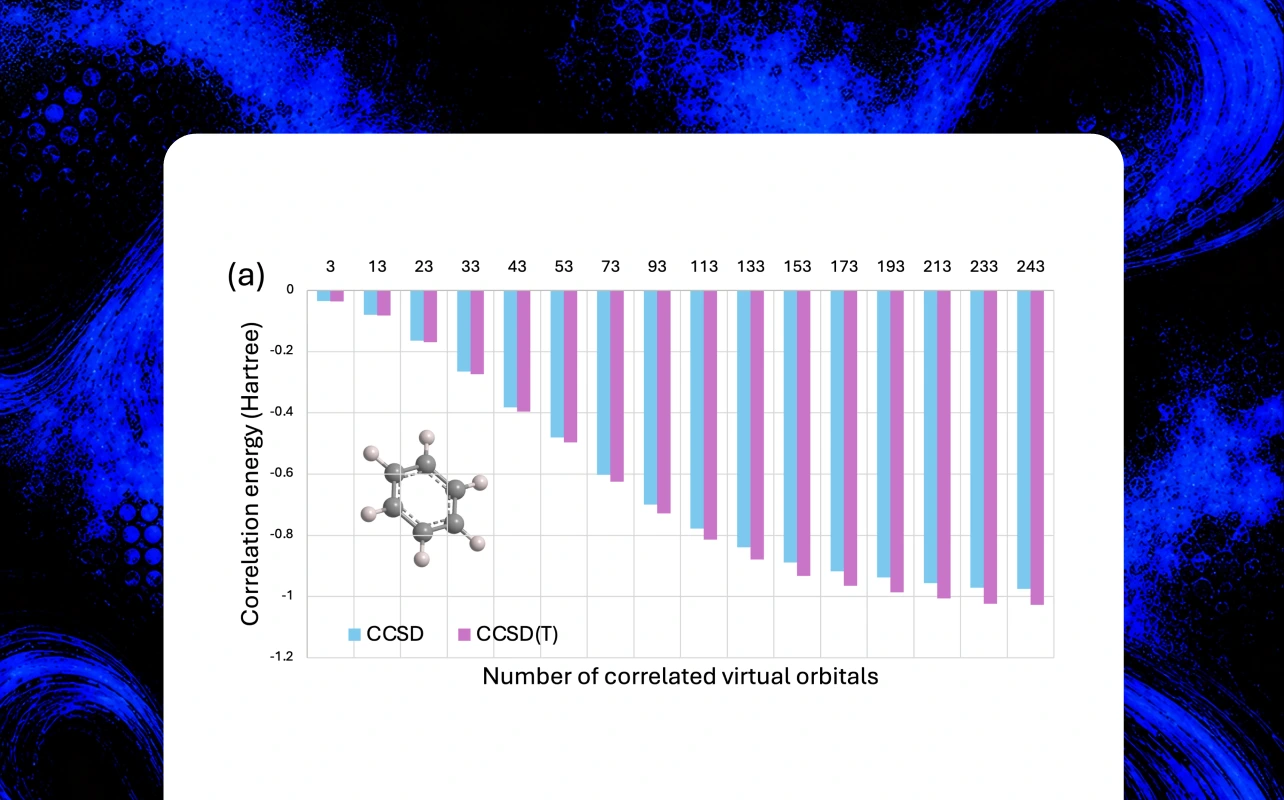
The paper quantifies how badly. For benzene in the cc-pVDZ basis, a CCSD(T) calculation restricted to a (6e,6o) active space recovers approximately 3% of the total CCSD(T) correlation energy. For the larger free-base porphyrin system, the same restriction recovers less than 1%. Active-space simulations on bare Hamiltonians are not enough.
Coupled cluster downfolding constructs an effective Hamiltonian whose dimension is tuned to the available quantum resources, but which encapsulates the dynamical correlation effects from outside the active space. The classical computation builds the downfolded Hamiltonian; the quantum computation finds its ground-state eigenvector.
The authors package this as QRDR, a Quantum Infrastructure for Reduced-Dimensionality Representations, with three components: highly scalable classical codes to compute downfolded Hamiltonians, four quantum solvers, and a state-vector simulator specialised for HPC systems.
| Component | Detail |
|---|---|
| Quantum solvers | ADAPT-VQE, qubit-ADAPT-VQE, the generator-coordinate-inspired GCIM method, and a VQE on the generalized unitary coupled cluster ansatz UCCGSD |
| Benchmark systems | N2 in cc-pVTZ, benzene in cc-pVDZ and cc-pVTZ, free-base porphyrin C20H14N4 in cc-pVDZ |
| Active spaces used on hardware | (6e,6o), six active electrons in six active orbitals |
| Effective Hamiltonian ansatz | Double unitary coupled cluster, DUCC(3)-A(7) |
| Hardware | Quantinuum H1-1 trapped-ion, IBM ibm_marrakesh and ibm_kingston superconducting |
| Error mitigation | Zero-noise extrapolation on the Quantinuum runs, QESEM via Qiskit Functions on the IBM runs |
With or without error mitigation, almost all the hardware estimates from the H1-1, ibm_marrakesh and ibm_kingston runs significantly outperform the source energies from the CCSD method that supplied the external cluster amplitudes used to build the downfolded Hamiltonians.
The authors name this accuracy amplification, and read it as evidence that the downfolding procedure is genuinely capturing out-of-active-space correlation.
This is third-party work. Qedma is not an author on the paper. The team selected QESEM for the IBM hardware runs and states plainly that QESEM outperformed Qiskit Runtime’s built-in zero-noise extrapolation and the other error mitigation methods they trialled, which is why only the QESEM results are reported for those devices.
For a quantum chemistry team evaluating error mitigation options, an independent national-laboratory benchmark carries a different weight than a vendor claim. The mechanism behind the accuracy difference is set out in the paper on reliable high-accuracy error mitigation.
It is a dimensionality-reduction technique that folds correlation effects from outside a chosen active space into an effective Hamiltonian defined inside it, so a smaller quantum computation can still account for the physics of the larger problem.
Active space size is bounded by qubit count, gate fidelity and circuit depth on current hardware. Downfolding lets the problem size be tuned to the available quantum resources instead of the other way round.
The authors position it as a bridge. The same flexible pipeline scales its active space upward as hardware improves, spanning noisy intermediate-scale devices and future fault-tolerant systems.
QESEM, accessed as a Qiskit Function. The paper reports it outperformed Qiskit Runtime’s built-in ZNE and the other methods trialled.
Another independent group applied QESEM to molecular symmetry analysis in point-group symmetry analysis of many-electron wavefunctions. More research is collected on Qedma’s academic papers page.
The full QRDR architecture, the classical benchmarking, the energy tables and the device specifications are in the paper.
Bauman, Zheng, Liu, Myers, Panyala, Peng, Li and Kowalski, arXiv:2507.01199.