Research
Resolving Structure in Prethermal Floquet Dynamics with Precision Quantum Computation

Resources Research Papers Last updated
This is the primary technical reference for QESEM, Qedma’s quantum error suppression and error mitigation software. The paper shows how QESEM makes unbiased error mitigation practical at utility scale by dramatically reducing the QPU time required to reach a target accuracy, while remaining robust to hardware drift. It demonstrates these capabilities on large-scale quantum circuits and benchmarks QESEM against heuristic methods such as zero-noise extrapolation.
Unbiased error mitigation methods such as probabilistic error cancellation can, in principle, recover the ideal result without relying on uncontrolled extrapolation or rescaling. Their main limitation is cost: as circuits become larger and noisier, the QPU time required to achieve a given statistical accuracy can grow prohibitively.
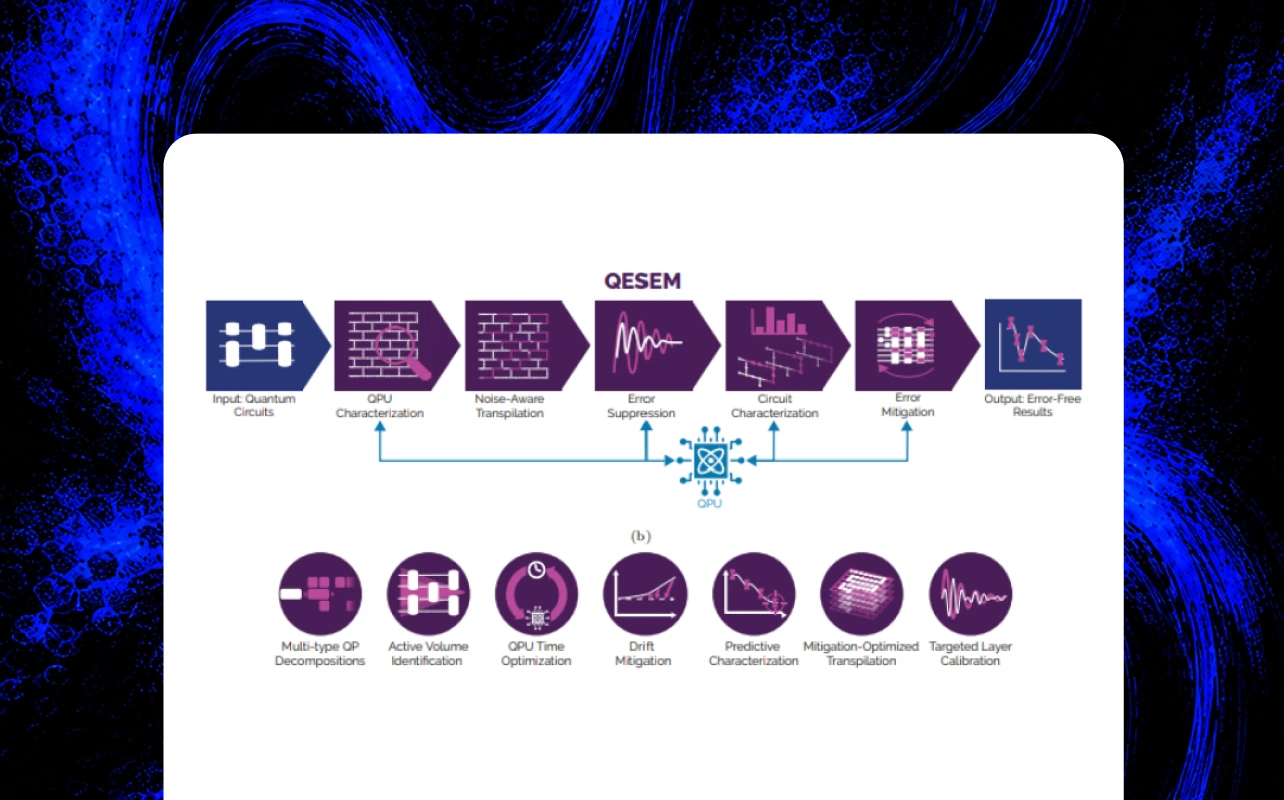
QESEM addresses this bottleneck by optimizing the full mitigation workflow. It combines error suppression, mitigation-aware transpilation, active-volume reduction and efficient quasi-probabilistic decompositions to substantially reduce the sampling overhead required to reach a target accuracy.
QESEM also continuously characterizes the device during execution and adapts to changes in its noise, making the mitigation robust to hardware drift and calibration changes that can otherwise introduce systematic errors into long-running experiments.
The paper demonstrates these capabilities on large-scale Hamiltonian-simulation and Quantum Chemistry experiments, including the largest utility-scale error-mitigation experiment performed using an unbiased method. It also compares QESEM with several variants of zero-noise extrapolation, showing the advantage of a rigorously grounded approach on the tested circuits.
| Stage | What it does |
|---|---|
| Device characterization | Rapidly characterizes the full device, identifying suppressible coherent errors and mapping operation fidelities to guide qubit selection. |
| Noise-aware transpilation | Generates candidate transpilations, predicts the characterization and mitigation cost of each, and selects the one with the lowest estimated QPU time. |
| Active volume identification | Identifies the noisy gates that can affect each observable, allowing gates outside its causal lightcone to be excluded from mitigation without sacrificing accuracy. |
| Error suppression | Reconfigures and calibrates native operations to suppress coherent errors before mitigation, reducing the noise that the mitigation stage must handle. |
| Predictive circuit characterization | Infers an error model for the transpiled circuit, covering Clifford and fractional two-qubit gate layers as well as state-preparation and measurement errors. |
| Adaptive resource optimization | Runs an initial small mitigation batch, then optimizes the number of sampled circuits and shots to reach the target uncertainty with minimum QPU time. |
| Drift-robust mitigation | Samples from the quasi-probabilistic decompositions while continuously updating the error model to remain robust to hardware drift, producing each observable with an estimate and uncertainty. |
Two efficiency levers are particularly important. Noise-aware transpilation can reduce QPU time by up to 1000× by selecting circuit implementations optimized for mitigation cost. Multi-type quasi-probabilistic decompositions efficiently mitigate both Clifford and fractional entangling gates, reducing circuit depth by up to 2× compared with standard mitigation methods that are incompatible with fractional gates.
| Demonstration | What it shows |
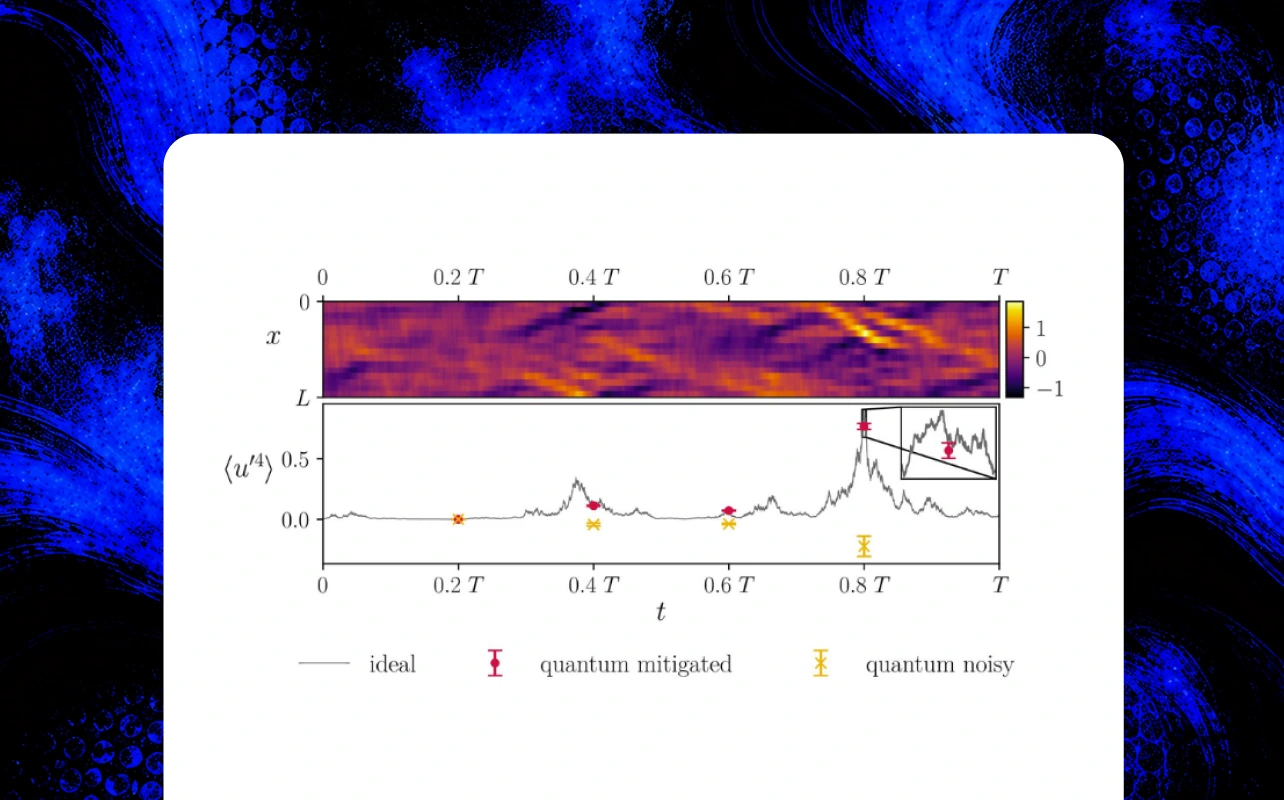
| Utility-scale Hamiltonian simulation — IBM Heron | QESEM mitigates a kicked-Ising simulation on a 103-qubit region, reaching 832 fractional entangling gates and an active volume of 301 gates for local observables. The experiment demonstrates unbiased QP-based mitigation at a scale where standard PEC would be computationally impractical. |
| Quantum Chemistry benchmark — IBM Heron | An 8-qubit H₂O circuit with 65 measurement bases tests QESEM on a generic, non-periodic workload. Nine-way patch parallelization reduces the QPU time required for a given precision by approximately 5x. |
| Cross-platform demonstrations — IBM Eagle and IonQ Aria | Additional Hamiltonian-simulation and molecular-circuit experiments demonstrate QESEM across substantially different superconducting and trapped-ion hardware platforms. |
Together, these experiments demonstrate QESEM at utility scale, on generic application circuits, and across different quantum hardware platforms.
The paper also sets out methods for estimating QESEM’s runtime in advance, either analytically from effective circuit parameters or through short dedicated time-estimation executions. This allows users to plan QPU resources around a target accuracy before committing to a full mitigation run. The same runtime models also underpin the paper’s closing projections of QESEM performance toward verifiable quantum advantage on near-term devices.
An unbiased error-mitigation estimator is mathematically constructed to recover the noise-free result for the errors captured by its noise model. More samples reduce the statistical uncertainty rather than an inherent mitigation bias. In practice, accuracy therefore depends primarily on how well the device noise is characterized. This differs from heuristic methods such as ZNE, which also rely on assumptions about how a circuit’s result changes as noise is amplified; if those assumptions fail, more samples can simply converge more precisely to the wrong answer.
Active volume captures the part of a circuit that matters to a target observable: the noisy operations, including idles, whose errors affect its outcome and therefore need to be mitigated. Operations outside the relevant lightcone can be ignored without incurring mitigation bias. QESEM further reduces that volume by identifying operations whose errors have negligible effect on the observable, lowering mitigation overhead while controlling the resulting bias.
QESEM supports both superconducting and trapped-ion quantum processors. In particular, IBM Heron and Eagle systems and IonQ Aria are demonstrated here. Extending QESEM to additional hardware platforms primarily requires adapting its characterization modules and corresponding error models.
No. Error mitigation and error correction are complementary. QESEM addresses physical errors without the qubit overhead required for encoding. The same mitigation principles can also be applied to residual logical errors after error correction. Moreover, syndrome information can be used to further improve mitigation at the logical level. The broader role of error mitigation alongside error correction is discussed in On the Importance of Error Mitigation for Quantum Computation, while syndrome-aware logical error mitigation presents a concrete protocol for combining the two.
For QESEM applied at the edge of classical simulability, see how error-mitigated quantum computers are reaching beyond state-of-the-art classical simulation. More research is collected on Qedma’s academic papers page.
The full workflow, the error model, the complete experimental data and the projections toward quantum advantage are in the paper.
Aharonov, Alberton, Arad, Atia, Bairey and 34 co-authors, arXiv:2508.10997.