Research
Resolving Structure in Prethermal Floquet Dynamics with Precision Quantum Computation

Resources Research Papers Last updated
A team from JSR Corporation, Keio University, Deloitte Tohmatsu, TCG CREST, Mitsubishi Chemical and IBM Quantum has proposed a practical way to read the point-group symmetry of a many-electron wavefunction directly off a quantum computer. The method is ancilla-free, works for both abelian and non-abelian point groups, and was validated on IBM superconducting hardware using up to 32 qubits. Qedma’s QESEM was one of the two error mitigation methods used to recover noise-free values.
A point group is the set of spatial symmetry operations of a molecule. In chemistry it is the standard tool for classifying molecular orbitals and electronic states, and it underpins the interpretation of spectroscopy, the Jahn-Teller effect and the Woodward-Hoffmann rules.
Quantum algorithms that exploit symmetry have been proposed for years. What has been missing is an efficient implementation of point-group symmetry operations on hardware, and a way to analyse the symmetry properties of realistic wavefunctions once you have them.
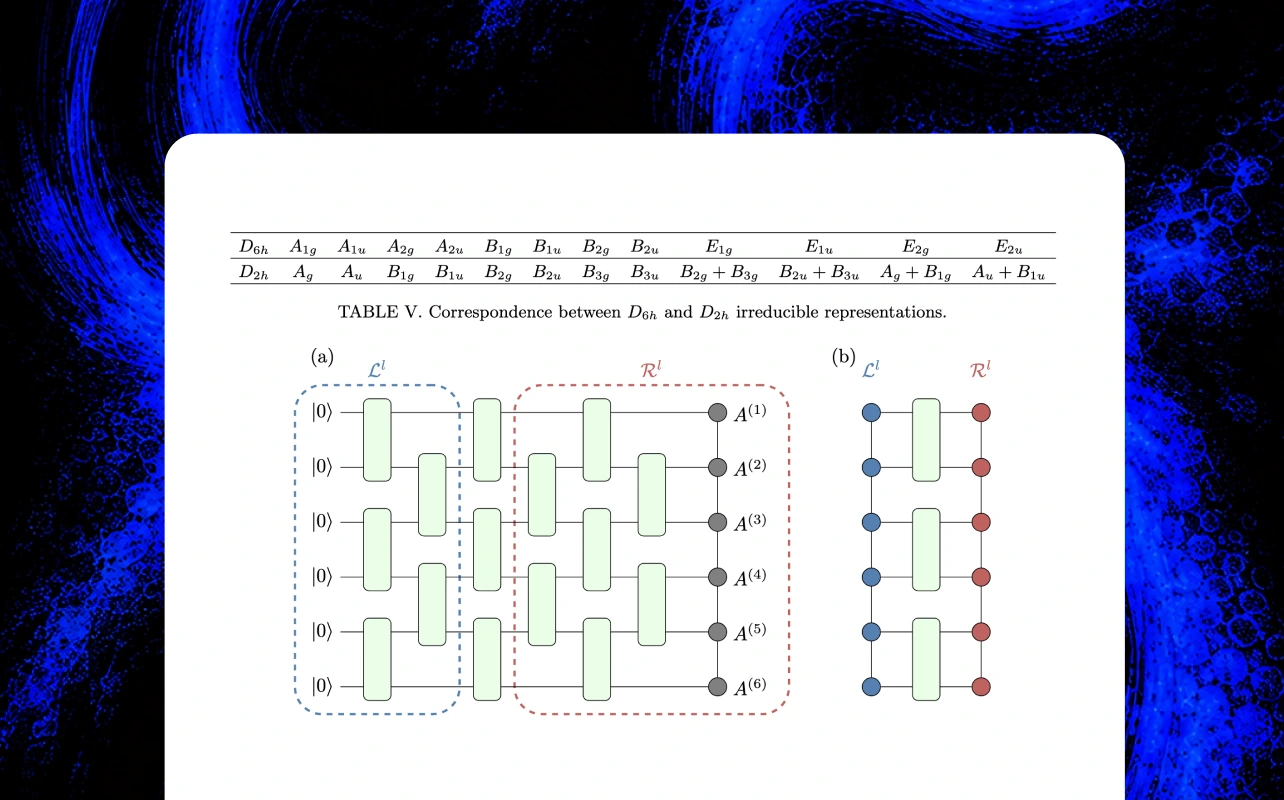
For a given wavefunction, the method calculates the projection weights of the point-group irreducible representations. It does this by applying orbital rotations derived from the eigenvectors of the representation matrices, which makes it applicable to arbitrary basis functions rather than only to symmetry-adapted ones.
The circuit cost is the practical point. Under the Jordan-Wigner transformation, the symmetry operation reduces to an orbital rotation implementable with Givens rotations. For the symmetry-adapted, mean-field orbitals used in most calculations, such as Hartree-Fock or Kohn-Sham orbitals, the depth is O(1). For general orbitals it is O(n) in the number of spatial orbitals.
Avoiding ancilla qubits matters because the alternative, a Hadamard test, requires long-range controlled operations that are poorly suited to devices with local qubit connectivity.
| Element | Detail |
|---|---|
| Molecules simulated numerically | Benzene and ferrocene |
| Hardware demonstration | Ground state and first excited state of benzene in D2h symmetry |
| Device | IBM ibm_kawasaki superconducting processor |
| Active spaces | (10e,8o), (10e,12o) and (10e,16o), corresponding to 16, 24 and 32 qubits |
| Wavefunction preparation | DMRG states converted classically to a brick-wall ansatz via a tensor-network technique |
| Error mitigation compared | Zero-noise extrapolation with gate folding in Qiskit, and the quasi-probabilistic approach implemented in QESEM |
| Result | Emphasize that they are faithfully reproduced only with QESEM while Qiskit ZNE shows bias |
On real hardware, the unmitigated estimates deteriorated as the size of the active space (number of qubits) grew. In the 32-qubit calculations, the measured weights of the correct symmetry representations fell to about 0.54, compared with exact values close to one. Gate-folding zero-noise extrapolation improved the results but retained a noticeable bias, while QESEM reproduced the target weights within a few percent. The authors therefore identify accurate noise characterisation and removal as essential for this type of measurement. A mitigation method that is fast but biased will distribute the error unevenly across representations and can misclassify a state.
The authors note that the demonstration is useful not only for analysing a given wavefunction, but also as a benchmark for the quantum devices and the error mitigation techniques themselves.
QESEM is an unbiased method built on quasi-probabilistic mitigation, which is why it is a natural fit for this class of measurement. The framework behind it is set out in full in the paper on reliable high-accuracy error mitigation.
A point group is the finite group of spatial symmetry operations that leave a molecule unchanged. It is used to classify molecular orbitals and electronic states, and it determines which spectroscopic transitions are allowed.
No. The approach evaluates the symmetry expectation values by diagonalising the block representation matrices and measuring in the resulting basis, which removes the need for the ancilla and the long-range controlled operations a Hadamard test would require.
Up to 32 physical qubits on IBM’s ibm_kawasaki device, corresponding to a (10e,16o) active space for benzene.
The authors position it as a tool for near-term devices and for early fault-tolerant quantum computers, where symmetry analysis of realistic material simulations is still required.
Another independent group applied QESEM to a different quantum chemistry problem in coupled cluster downfolding theory. More research is collected on Qedma’s academic papers page.
The full method, the derivations for non-abelian groups, the ferrocene results and the complete hardware data are in the paper.
Sakuma, Sugisaki, Kanno, Itoko and Nakamura, arXiv:2605.24824.