Research
Resolving Structure in Prethermal Floquet Dynamics with Precision Quantum Computation

Resources Research Papers Last updated
Qedma researchers introduce SALEM, syndrome-aware logical error mitigation. It applies error mitigation to the residual logical errors of an error-corrected circuit, but conditions the mitigation on the error syndromes measured during error correction. The runtime overhead is exponentially lower than logical error mitigation schemes that ignore syndrome data, and the result is a substantially larger circuit volume that can be executed accurately.
Hardware roadmaps indicate that physical qubit numbers will remain limited for the foreseeable future. That leaves residual logical errors even after error correction, and those errors constrain how large and how accurate a computation can be.
Logical error mitigation was proposed to close the gap: apply error mitigation methods to the logical errors that error correction leaves behind, at the cost of a runtime overhead.
The existing approach, which the paper calls external logical error mitigation, treats the logical gates as if they were physical gates. It does not look inside them, and specifically it does not use the syndrome data measured within them. That data is already being collected. SALEM uses it.
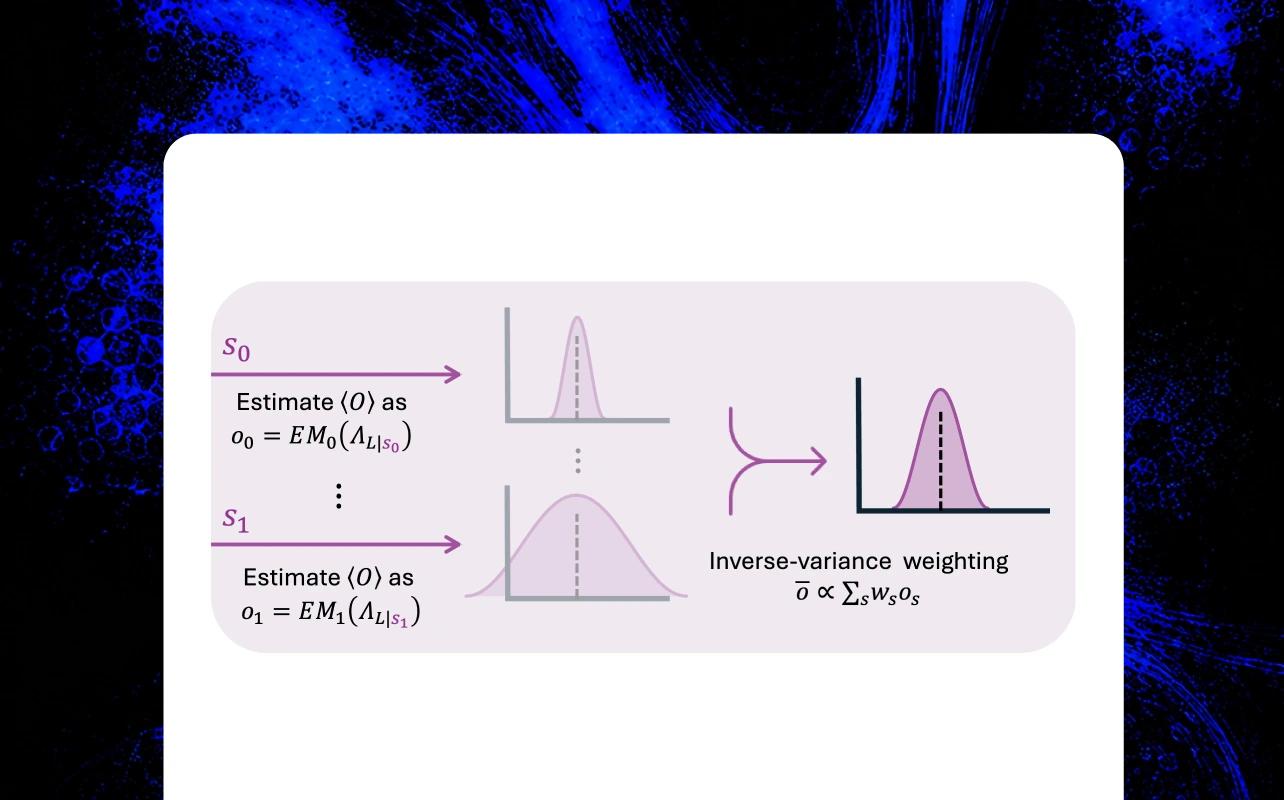
Restricting attention to shots in which a particular syndrome value was measured makes the syndrome-conditioned logical error channel the relevant error channel, and that channel is easier to mitigate than the syndrome-averaged one.
SALEM designs a separate mitigation protocol per syndrome, producing an unbiased estimator for each. Those estimators are then combined with inverse-variance weighting, giving a single unbiased estimate with significantly reduced shot overhead.
This is the distinction from post-selection. The standard way of using syndrome data is to accept or reject shots, which is a binary weighting. That leaves residual bias from logical errors inside the accepted syndromes, and it discards the information in the rejected ones. SALEM keeps every shot and weights it.
The comparison below is drawn from the paper’s Figure 2, based on a distance-4 surface code memory at a physical error rate of 10^-3 with a logical error rate of approximately 10^-4, with every method allocated the same space and time overhead.
| Method | Circuit volume at 99% required accuracy, relative to SALEM |
|---|---|
| SALEM | Baseline |
| External logical error mitigation | SALEM sustains volumes over 2x larger |
| Error correction with post-selection | SALEM sustains volumes 20x larger |
| Error correction alone | SALEM sustains volumes 200x larger |
Two structural points follow. Methods limited by bias, which includes error correction alone and error correction with post-selection, provide a circuit volume boost that barely improves as you relax the accuracy requirement. Methods limited by statistical error, which includes error mitigation, external logical error mitigation and SALEM, scale inversely with the allowed inaccuracy and are therefore better precisely where high accuracy is needed.
The fault tolerance threshold is normally the point at which error correction starts to help. The paper reports that in the logical error mitigation setting this is no longer the right marker.
For sufficiently large circuit volumes SALEM’s threshold surpasses the standard fault tolerance pseudo-threshold and continues to increase with volume, and the paper notes this already happens at practical volumes. The consequence is that error correction combined with SALEM can outperform physical error mitigation above the standard fault-tolerance threshold, meaning error correction becomes useful in a regime of physical error rates where it is usually considered useless.
This is a result about how error suppression, error mitigation and error correction compose, rather than compete.
It is the application of quantum error mitigation methods to the residual logical errors that remain after quantum error correction has been applied, in order to increase the circuit volume that can be executed to a given accuracy.
Post-selection accepts or rejects shots based on the syndrome, a binary weighting that leaves bias in the accepted shots and discards the rejected ones. SALEM mitigates each syndrome-conditioned error channel separately and combines the resulting unbiased estimators with inverse-variance weights, keeping all shots.
No. It uses syndrome data that error correction already measures. The change is in how that data is used during mitigation and post-processing.
The paper argues the opposite is also true: SALEM makes error correction worth using at physical error rates above the standard fault-tolerance threshold, where error correction alone would not help.
SALEM operates on logical circuits. For the physical-level equivalent, see QESEM and the paper on reliable high-accuracy error mitigation. More research is collected on Qedma’s academic papers page.
The full protocol, the fine-grained and coarse-grained variants, the threshold analysis and the surface code simulations are in the paper.
Aharonov, Atia, Bairey, Brakerski, Cohen, Golan, Gurwich, Lindner and Shutman, arXiv:2512.23810.