Research
Resolving Structure in Prethermal Floquet Dynamics with Precision Quantum Computation

Resources Research Papers Last updated
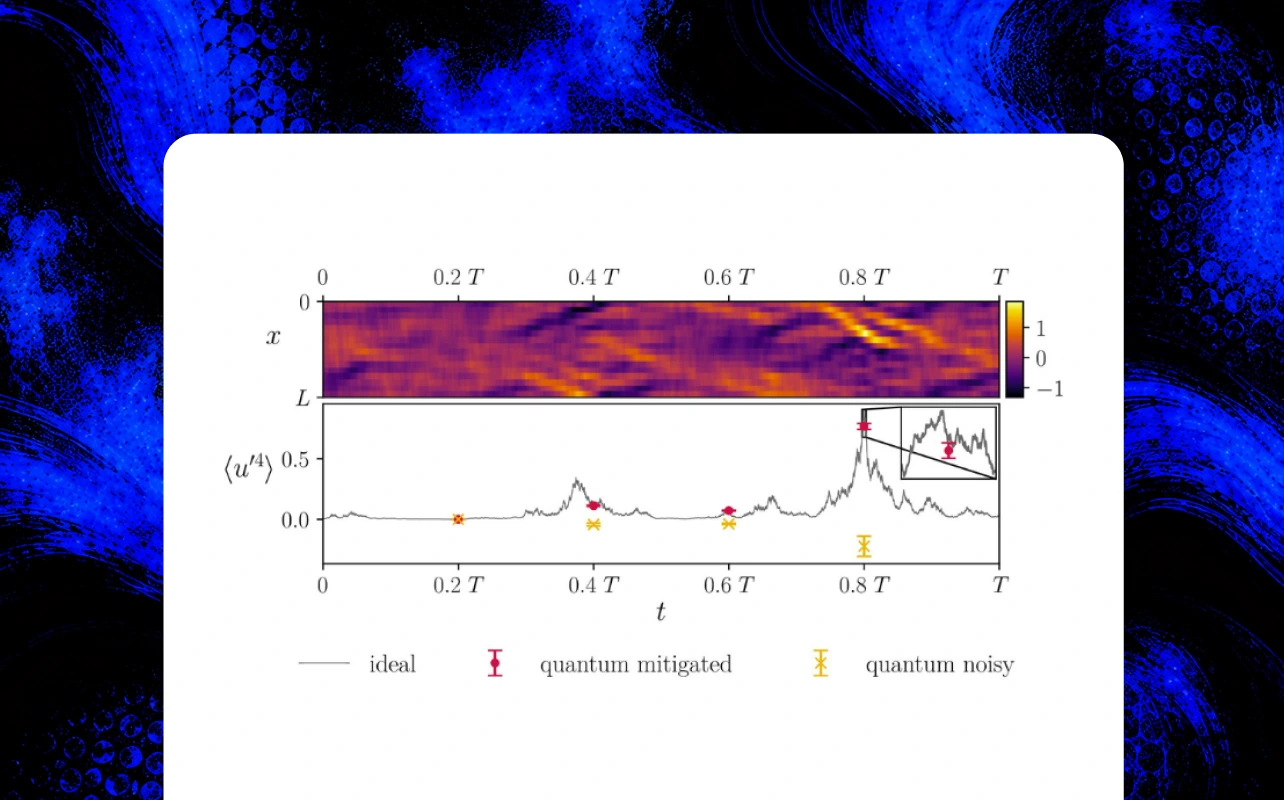
Researchers at DESY, TU Berlin, The Cyprus Institute and Qedma address the readout bottleneck in quantum computational fluid dynamics. Starting from a quantum state which amplitude-encodes a velocity field, they show how to directly estimate statistical properties, central moments and structure functions directly, without reconstructing the full velocity field. The approach was run on IBM’s 156-qubit Heron r2 device ibm_fez using Qedma’s QESEM, with total QPU usage of not more than 40 minutes.
Amplitude encoding is what makes quantum algorithms attractive for fluid dynamics: 2^n spatial points fit into n qubits. While evolving an n qubit state by the Burgers’ equation has been widely studied, extracting the field remains impractical and requires dedicated readout strategy.
A quantum algorithm returns a quantum state, not a solution vector, and reading detailed information back out generally requires a number of measurements that scales exponentially with system size. Even storing or processing a velocity-field vector with 2^n entries becomes impractical at large n. This cost can eliminate the memory advantage that made amplitude encoding attractive in the first place.
Approximate readout methods exist, including compressed sensing and MPS tomography, but they rely on additional assumptions such as low-rank structure or restricted entanglement that do not hold in general CFD settings.
In turbulence research, the full velocity field is often not the quantity of interest. What matters are statistical descriptors. The paper targets two of them.
Central moments of the spatial velocity distribution at a fixed time step. The second moment relates to turbulence intensity and the kinetic energy of the fluctuating part of the flow. The third relates to skewness and to anisotropy. The fourth relates to flatness, a measure of intermittency that highlights extreme events.
These moments are sensitive to shock-like structures, which appear in the Burgers’ equation as steep gradients driven by the nonlinear advection term, so a shock leaves a statistical signature even when the field is never explicitly reconstructed.
Structure functions, which describe how velocity differences scale with separation distance and reveal correlation lengths, coherent structures and scaling properties across length scales.
Both are extracted directly from the ansatz circuit through a tailored measurement strategy, with no tomography step.
| Element | Detail |
|---|---|
| Governing equation | One-dimensional viscous Burgers’ equation |
| Encoding | Amplitude encoding, 16 spatial points on 4 qubits |
| Test cases | A sine wave signal and four snapshots from Burgers’ equation evolution |
| Device | IBM Heron r2 ibm_fez, 156 qubits, heavy-hexagonal lattice |
| Error mitigation | Qedma’s QESEM |
| QPU time per job | Under 3 minutes |
| Total QPU time for all results in the paper | Not more than 40 minutes |
The circuits were designed with hardware-aware modifications for IBM’s heavy-hex topology, and several observables and time steps were combined into single circuit executions to reduce job count.
The whole argument depends on a small number of scalar quantities being accurate. If the moments are biased, the statistical signature of a shock might be lost in the noise.
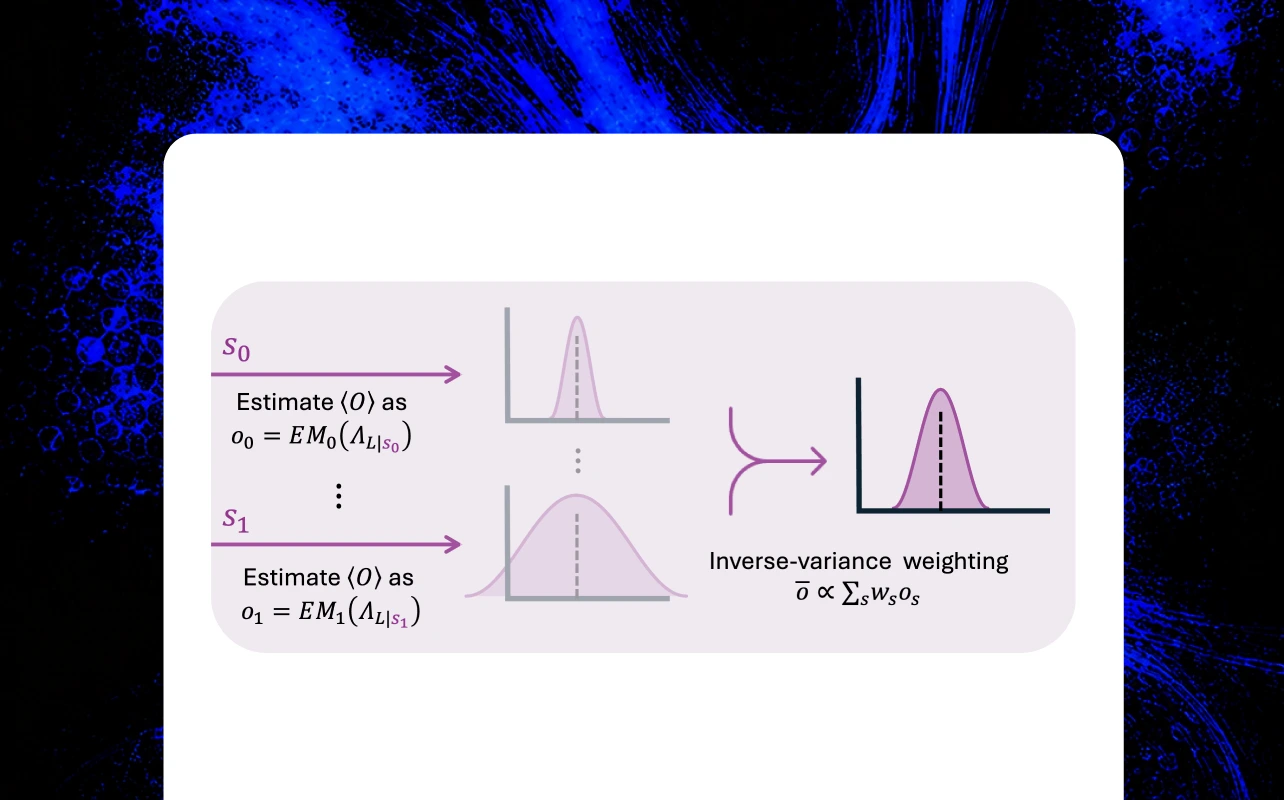
The authors report that extraction of these few but informative statistical values is feasible on noisy hardware when error mitigation is applied, and use QESEM to reduce noise-induced biases in the measured data. QESEM also supplies error bars on the mitigated estimates, allowing their reliability to be quantified. The accuracy guarantees behind those error bars come from the unbiased framework described in the paper on utility-scale error mitigation.
It is the difficulty of extracting useful physical quantities from a quantum state that encodes a fluid field. Retrieving the field point by point requires a number of measurements that scales exponentially with the number of qubits, which erodes the advantage of the compact encoding.
No. Central moments and structure functions are computed directly from the parameterised ansatz circuit through a tailored measurement strategy.
No. Burgers’ turbulence is the demonstration case. The authors state the concept is applicable to other equations and contexts.
IBM’s Heron r2 system ibm_fez, a 156-qubit superconducting device with a heavy-hexagonal lattice.
For a case where error-mitigated hardware resolved dynamics that leading classical methods could not, see how error-mitigated quantum computers are reaching beyond state-of-the-art classical simulation. More research is collected on Qedma’s academic papers page.
The measurement strategy, the circuit design for heavy-hex devices and the full hardware results are in the paper.
Goldack, Atia, Alberton and Jansen, arXiv:2601.10166.